Tag: Board Game

  • Fun in the Classroom: How Dare You

    Some Problems

                You may not have noticed, but excellent teaching is hard work. In case that obvious statement needs clarification: adult learners get bored when you drone on simply lecturing for 3 hours a week. Even adult learners are limited to 25 minute attention spans before you lose them.[1] Lecture-only tendencies fail other learning styles. Lecture-only techniques typically require the learner to create his own motivation. It is like offering a spoonful of rice to a starving man. Sure, the rice is healthy, but with only this much to offer, his starvation continues. Utilizing games in the classroom is one way educators can vary their approach, reach more learning styles, and motivate learners. Herodotus wrote a history of the Greeks that recorded a certain period of famine and the populace’s response.

    “For some time the Lydians bore the affliction patiently, but finding that it did not pass away, they set to work to devise remedies for the evil. Various expedients were discovered by various persons; dice, and knuckle-bones, and ball, and all such games were invented… The plan adopted against the famine was to engage in games one day so entirely as not to feel any craving for food, and the next day to eat and abstain from games. In this way they passed eighteen years.”[2]

    So, during a time of literal famine, the general populace took to games to improve their lives. Educators can and should utilize games in teaching in order to reach more learners with better quality teaching.

    But What is the Value of Games in Education?

                Google phrases like “games for personal and social change,” “positive impact games,” “social reality games,” “serious games,” or “leveraging the play of the planet.” Visit websites like Game For Change, or Serious Games Interactive. No, go ahead. I can wait.

    The men and women working on these sites, programs, and initiatives are on the leading edge of utilizing gaming for education. Granted, the majority of what you will find in these searches are video games, and you should know that there is nothing wrong with that.

    Don’t be afraid. You don’t need to become a visual artist or programmer to use gaming in your classroom. Teachers have used games for millennia, and not just to educate children. Jane McGonigal rightly asserts that games will “satisfy our hunger to be challenged and rewarded, to be creative and successful, to be social and part of something larger than ourselves.”[3] You can use traditional classroom games that have been around for decades, board games, card games, simulation games, video games — the sky is the limit.

    Games empower the learners. They learn skills, they engage with the material, and – with some work – you can tie many game elements to your teaching material. With this increased investment, the learners will care more about your subject, which will fuel further learning.

    Examples for the Classroom

                Consider using a roleplaying game. Marlene D. LeFever gives a good, easy system for a game like this called “Guidance.”[4] In addition, more popular roleplaying systems are available, including Dungeons & Dragons,[5] Pathfinder, and Star Wars: Edge of the Empire. Roleplaying games can be carefully crafted to interact with specific material in your class, whether it is a psychology, sociology, counseling class, and more. It allows the learner to step into different shoes and gain new perspective on your topic.

    Consider developing your own. I, myself, have begun work on a simulation/strategy game that teaches the socio-economic context of the Roman Empire. Consider what you want to teach, the values of the best games (see McGonigal, above), and how you might go about doing that. Start building rules and test it until it’s where you want it to be!

    Finally, I suggest visiting your local game store to ask if they have anything that relates to your topic. In addition, consider searching BoardGameGeek.com for games related to your topic.


    [1] Freddy Cardoza, class lecture, “Teaching Adults,” Spring 2014.

    [2] George Rawlinson, trans., with Henry Rawlinson and J. G. WIlkinson, The History of Herodotus: A New English Version (New York: D. Appleton, 1861), 181-82. (http://archive.org/stream/historyofherodot01herouoft#page/182/mode/2up, accessed 4/26/2014.)

    [3] Jane McGonigal, Reality is Broken (New York: Penguin Press, 2011), 10.

    [4] Marlene D. LeFever, Creative Teaching Methods, Revised Edition (Colorado Springs: NexGen, 2004), 142-66. This classic book has several other examples worth examining, too. See also Robert Heinich, Michael Molenda, and James D. Russell, Instructional Media, 2nd Edition (New York: John Wiley & Sons, 1985), 304-25.

    [5] If you’re wondering, no, the Devil did not create this game. Maybe another blog post for another time…

  • Forbidden Island and Cooperative Gaming

    Last time I wrote a game review, I told you about Carcassonne, a competitive game that keeps everyone in the game until the very end (unlike Monopoly).

    This week, I’m going to describe a very different game. “Forbidden Island” is a cooperative game for 2-4 players and takes about 30 minutes to play. If you enjoy board games and Indiana Jones movies (though we must not speak of any Crystal Skulls…), you will like this game. In a nutshell, Forbidden Island is a game where a group of adventurers have come to the island to recover four elemental artifacts (they BELONG in a MUSEUM!), but the long-gone inhabitants booby-trapped the island: the whole island begins sinking!

    The only way to win the game is if everyone works together to recover all four artifacts and escape before the sea claims them. But there are PLENTY of ways to lose. In Forbidden Island, you don’t play against each other, you play against the game, which makes for a great experience and makes both victory and defeat so sweet! I think I’ve won the game as many times as I’ve lost. If you get better at it than my group, you can increase the difficulty of the game by increasing the rate of the island’s flood.

    You’ll enjoy the quality artwork on all the cards and island tokens, as well as the production value of the whole package (it comes in a tin box, and all the pieces are high quality). I plan to introduce my kids to Forbidden Island around age 7 or 8. It encourages group problem solving, cooperation, and critical thinking.

    Forbidden Island
    Forbidden Island

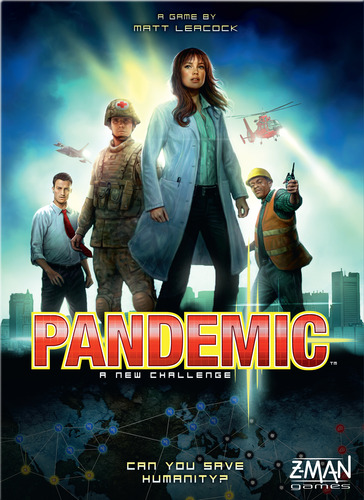
    Interested in a game designed by the same person, but harder and with higher stakes? Take a look at Pandemic. This game takes about 45 minutes, rather than 30, but it is another cooperative game. This time, you are a team from the Centers for Disease Control trying to save the world from a global pandemic consisting of four diseases (or more, if you get the expansion!). This game is MUCH more difficult, and I think I’ve won about 2 times out of every time I’ve tried it. But the game is just that much fun. I’m not mad that I’ve lost. I’m resolved to try again! I highly recommend it.

    Pandemic
    Pandemic
  • Game Review – Carcassonne

    This week I’m going to talk to you about gaming.

    One game in particular, actually.

    This game is my wife’s favorite board game, and it is one of mine, too. This game? It’s Carcassonne.

    Originally published in the year 2000, it is still a regular sight on the shelf in your Friendly Local Game Store. It plays with 2 to 5 people and games usually run about 45 minutes.

    The basic idea for the game is that you and the other players are building up towns, roads, monasteries, and farmlands in the medieval French countryside. Each of you is vying for power by building the biggest towns, the longest roads, complete monasteries, and the most bountiful farmlands. It may sound complicated, but the game is actually quite simple.

    Here is the thing about Carcassonne – it is a board game where you build the board as you play. Each turn, you pull a random tile and have to place it strategically to get yourself the most points. Do you start a new city or build on one you’ve already started? Do you leave your neighbor’s city alone, or do you try to sneak in and share the points? Or, worse, do you try to take over the city? Or – most vexing for my wife – do you make the surrounding area so unusable that the player can’t even finish her city?

    You only have so many ‘followers’ to use at any one time, so you can’t claim a new road, city, farm, or monastery every turn. Do you wait on that farmland? What if somebody snatches it up before you come back to it?

    Maybe my favorite element of the game is the scoring. As you go through the game, it may look like there is a clear winner. The end of the game, however, triggers the final scoring that adds up everything that is unfinished (cities, roads, monasteries), and it finally scores the farmlands. It is at this moment in the game where I watched somebody in last place jump to first place and win the game. It isn’t like Monopoly where you go bankrupt and go watch TV while your friends finish the game.

    Everyone is in the game until the very end.

    If you’re curious, there are dozens of versions and expansions that give different kinds of gameplay. The base game is at rank 13 on BoardGameGeek.com’s Family Game Rank, if that tells you how fun this is. If you live in Marin County, you can easily get it through my favorite game store I’ve ever visited, Gamescape North, located on 4th St. (between B St. and C St.) in San Rafael. (No, I was not paid to include that in this post. I really do like that store that much.)

    Have any of you played Carcassonne or something similar? What are your favorite board games?