Death, be not proud, though some have called thee
Mighty and dreadful, for thou are not so;
For those whom thou think’st thou dost overthrow
Die not, poor Death, nor yet canst thou kill me.
From rest and sleep, which but thy pictures be,
Much pleasure; then from thee much more must flow,
And soonest our best men with thee do go,
Rest of their bones, and soul’s delivery.
Thou’art slave to fate, chance, kings, and desperate men,
And dost with poison, war, and sickness dwell,
And poppy’or charms can make us sleep as well
And better than thy stroke; why swell’st thou then?
One short sleep past, we wake eternally,
And death shall be no more; Death, thou shalt die.
-John Donne, “Sonnet X: Death Be Not Proud,” 1609
We are in the days leading up to Halloween. The debate is fresh all over again whether Christians can or should participate at any level. This blog post is not about that. I would rather spend a few minutes with you over the subject of remembering that you and I are mortal.
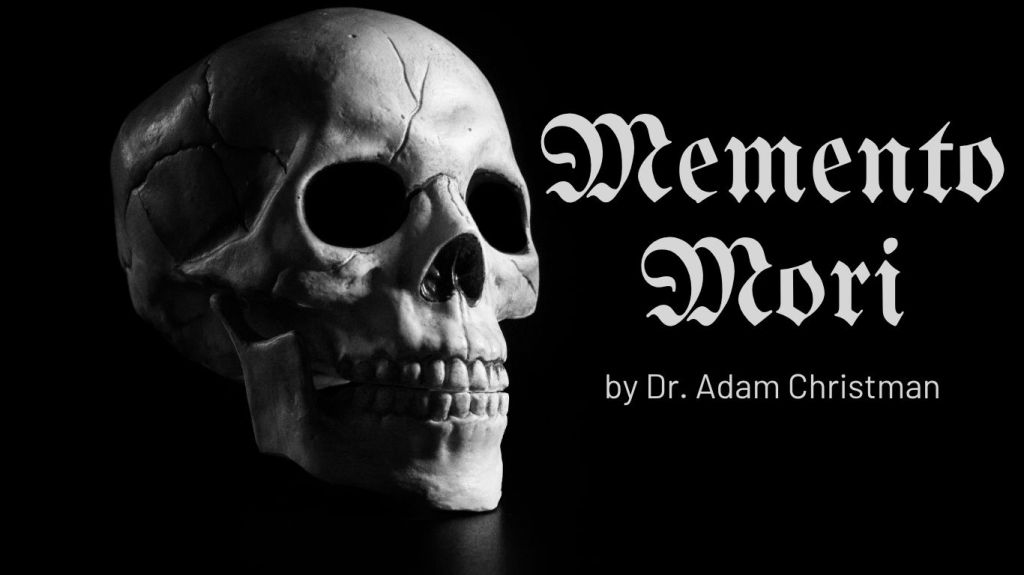
“Memento Mori” is a Latin phrase that is literally translated “Remember to die.” It may be better understood, though, with the intention of the wording, “Remember, you will die.” The origins of this particular phrase—and more specifically the origins of its repetition and rehearsal at various times—are unclear. Why discuss it? I believe that it is health to reflect on our mortality because it humbles us in the truth of our existence before a holy God. The Halloween season looks at, glances at, or takes death lightly in many cases. What better time to talk about death than now? The following paragraphs take us through a little history, then to some Scripture, and then to an opportunity to reflect on our mortality.
Tertullian is credited with recording a practice observed by at least some Roman emperors that utilizes the phrasing at the heart of this week’s blog post. Here is a quote from his famous treatise Apology, “Even when, amid the honours of a triumph, [the emperor] sits on that lofty chariot, he is reminded that he is only human. A voice at his back keeps whispering in his ear, ‘Look behind you; remember you are but a man.’” It is good to remind emperors (and all the rest of us) of their mortality. It humbles and puts things in perspective.
Plato1 and the Greek Stoics are credited with similar thinking. Marcus Aurelius wrote, “Let each thing you would do, say, or intend, be like that of a dying person.”2 Epictetus wrote, “I cannot escape death, but at least I can escape the fear of it.”3
The Bard reflected much on death in his tragedies, but especially in Hamlet. In that play, for example, he gives Hamlet’s mother, the queen, the following dialogue, “Thou know’st ’tis common; all that lives must die, passing through nature to eternity.” Hamlet replies with brevity, “Ay, madam, it is common.”
All mankind knows death is common. Death is an enemy that separates parents from children, husbands from wives, friends from one another… But I am not asking you to reflect on death. I am asking you to reflect on your mortality and, yes, there is a difference.
Psalm 39 is a psalm of David. The first two verses reflect David’s increasing stress and pain from dealing with the wicked. Then, he writes:
Lord, make me aware of my end and the number of my days so that I will know how short-lived I am. In fact, you have made my days just inches long, and my life span is as nothing to you. Yes, every human being stands as only a vapor.
Yes, a person goes about like a mere shadow. Indeed, they rush around in vain, gathering possessions without knowing who will get them.
Now, Lord, what do I wait for? My hope is in you. Rescue me from all my transgressions; do not make me the taunt of fools. I am speechless; I do not open my mouth because of what you have done. Remove your torment from me. Because of the force of your hand I am finished. You discipline a person with punishment for iniquity, consuming like a moth what is precious to him; yes, every human being is only a vapor.
Hear my prayer, Lord, and listen to my cry for help; do not be silent at my tears. For I am here with you as an alien, a temporary resident like all my ancestors. Turn your angry gaze from me so that I may be cheered up before I die and am gone. -Psalm 39:3-13
Knowing that your life is short changes things. What would you do differently if you knew you had two more years to live? Would you worry so much about what people think about your clothes or your haircut? Would you blow around in the gust of the latest “ragebait” online? Would you spend as much time on social media as you do now? Would you drive your car with entitlement, cutting people off and otherwise driving like a madman? Would you be so curt with your kids? Would you be distant from your husband or wife after a disagreement? Would you continue to neglect that phone call, text message, or (here’s an idea) that hand-written letter you’ve considered sending to that person you care about?
As a Christian, I have come to know that I am very, very mortal. Before I was a Christian I had to live with the effects of death. My father died when I was three weeks old. He and my mother were shocked to learn he was diagnosed with liver cancer after feeling weak for some days. In less than two months, he was gone. As far as I know, he never had a sip of alcohol in his life. He certainly was not a heavy drinker. But liver cancer came just the same. Death was an unwelcome houseguest in the Christman home, but there was nothing we could do about it. God did not see fit to raise my father back to physical life. When God saved me, I was thirteen years old. I began to discover what it meant to be a new creation, a child of God, and a future co-heir with Christ. Even so, it took me a long time to understand death, especially my father’s death. I read Philippians 1:21, which declares that, for Christians, “to die is gain.” I believe that, but it was hard to understand it well as a teenager or in my early 20’s. Over time, I have come to better understand God’s sovereignty and God’s plan for humanity. God did not design us to die. 1 Corinthians 15:26 says, “The last enemy to be destroyed is death.” Our species introduced sin into the world and the wages of sin is death. So it is frustratingly simple: death is a part of the world we live in. That truth will not change until Jesus returns.
The longer I walk with Jesus, the more I want to continually surrender to His call to die to myself (Mt. 16:24-25; Galatians 2:20). Jesus said in that Matthew 16 passage that it is how we follow Him. And, man. He’s the only one I want to follow 24/7.
A friend of mine has regularly said to me, “The dead know one thing. It is better to be alive.” I did not know, at first, that the quote is from the movie “Full Metal Jacket.” While that movie’s co-writer and director Stanley Kubrick seemed to be an atheist, that bit of dialogue continues to ring true. So I reflect on my mortality and I invite you to do the same. Consider the following statements and questions as you reflect on mortality. They are by no means exhaustive, but I hope they are helpful:
- I am mortal but God is not. He knows better about life, about me, about everything. Is there any reason not to trust His wisdom?
- I am mortal and I have done wrong in my life. I have even done wrong according to my own moral standard, which is admittedly lower than God’s. I need forgiveness from what I have done wrong. I need a clean slate. I thank God that He offers a clean slate through faith in Jesus!
- I am mortal. I have a limited amount of time on earth to love God in my lifetime. I better get busy doing that!
- I am mortal. I have a limited amount of time to love my family, friends, church, and neighbors well. How can I do that to the best of my ability?
- I am mortal. I cannot resurrect myself. But Jesus conquered death! God has saved me by grace through faith so that, when my eyes close in death, I will re-open them with a new body and in His glorious presence.
- I am mortal. What habits are truly a waste of my time? Habits of worry? Habits of laziness? Habits of addiction?
- I am mortal. Life is too short for hatred. Better to obey God and love my neighbors.
- I am mortal. Life is too short for bad pizza.
 A blog by Adam W. Christman
Leave a comment